


With temperatures reaching record highs across the world during the summer period, the demand for HVAC units in households and workplaces continues to rise.
Manufacturers are facing the prospect of huge influxes of orders in preparation for next year’s summer, which will lead many to start thinking about the efficiency of both their product and production processes.
With the heatwave seemingly coming to an end, now is the ideal time for manufacturers to begin exploring alternative bonding technologies that could help them increase speed of production, without causing major production disruptions on introduction.
The addition of insulation
More modern HVAC units contain some form of insulation. Depending on the type of insulation and the area, this can either be used to reduce temperature loss inside of the unit, or prevent moisture from forming on components such as pipework.
It’s slowly becoming an essential part of HVAC systems that helps to reduce energy consumption, which in turn, will lower the customer’s running costs. Furthermore, it can help to preserve equipment inside of the unit, leading to a reduction in the number of callouts and repairs.
How the insulation is installed is another question. Careful consideration needs to be taken given the conditions a bond or fitting would need to withstand, including moisture and high temperatures. Alongside this, an adhesive or fixing will most likely need to bond to a number of different substrates including metal, foils, plastics, composite materials and of course, the insulation material itself.
Tecbond sprayable hot melts
The Tecbond spray system is an established technology that enables manufacturers to safely and securely bond a wide variety of construction and assembly materials without the usual drawbacks of other sprayable systems such as water and solvent-based adhesives.
Utilising compressed air alongside traditional hot melt technology, the system “spiralises” the hot melt, spreading it very finely over a wider area than can be achieved with a standard hot melt tool. Not only is this more effective for large surface bonding, hot melts are VOC-free, helping to reduce reliance on respiratory PPE associated with solvent-based systems.
For HVAC assembly specifically, Tecbond hot melts are a great option for securing insulation and other non structural components. Integrating these hot melts would present manufacturers with an initial cost saving, without causing huge changes or disruption to current production processes.
The biggest advantage hot melts have over the more established alternatives is their speed of set. Hot melts provide near instant bonds across a range of different materials, meaning manufacturers don’t have to wait several hours before moving the product through the production process. Alongside this, Tecbond sprayable hot melts have ample open time, allowing for larger pieces of material to be positioned and bonded, without the worry of the adhesive solidifying too early.
When the final bond is in place, the hot melt is unaffected by moisture, making it an ideal solution for bonding insulation to components that are prone to condensation buildup, and even prevent them from forming condensation entirely in the case of refrigerant lines.
To meet the rising demand for additional safety specifications, many Tecbond formulations are also UL 2395 certified, supporting compliance with relevant fire performance requirements, and ensuring long term performance under HVAC’s operating temperatures. This certification is updated yearly to ensure the adhesive always meets specifications.
How do hot melts compare with other HVAC adhesives?
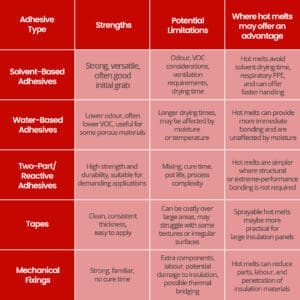
Although limited to certain applications within units, Tecbond hot melt compares particularly well against some of the most common bonding methods currently used.
The table below highlights the strengths and potential limitations of each bonding method, and where hot melts may offer an advantage.
A faster, simpler route to HVAC bonding
As HVAC manufacturers prepare for potentially increased demand, improving assembly efficiency will be just as important as improving the performance of the unit itself.
Tecbond sprayable hot melts offer a practical solution for manufacturers looking to bond insulation and other non-structural materials quickly, without compromising on bond strength. Where speed of set, wide-area coverage, certification and process simplicity are priorities, these hot melts can provide a valuable alternative to more time-consuming bonding methods.
Tecbond 425


