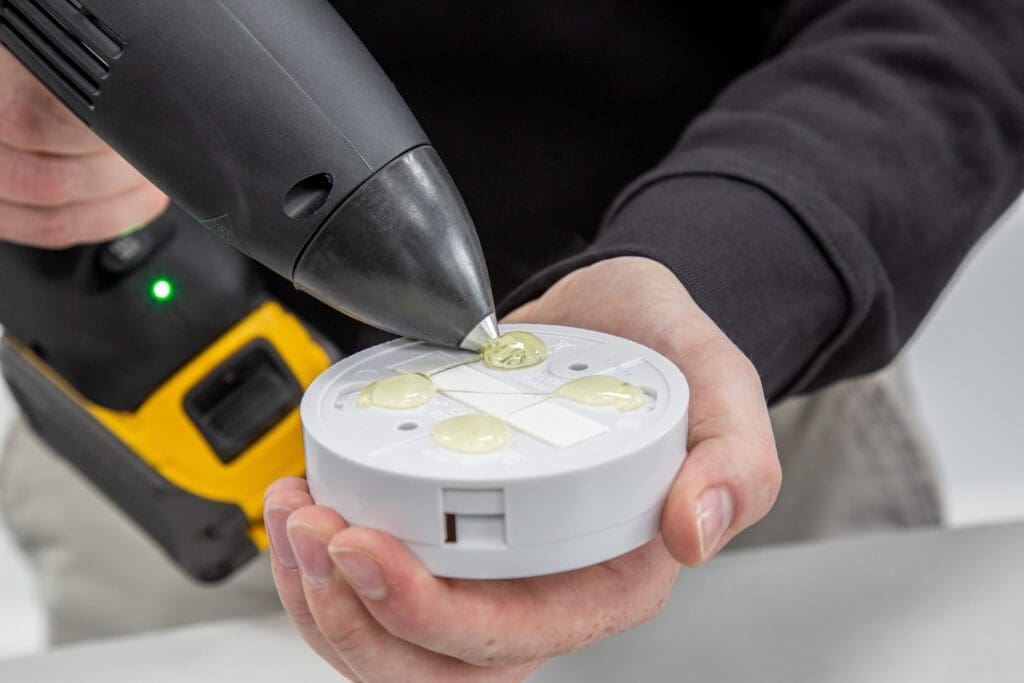
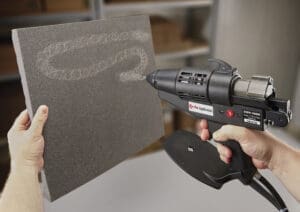
UK-headquartered Power Adhesives, a global leader in hot melt adhesive solutions, will be at BAU 2025 in Munich, the world’s premier trade fair for architecture, materials, and systems, presenting live demonstrations of its pioneering Tecbond spray hot melt technology and offering visitors a firsthand look at its efficiency, versatility, and cost-saving benefits.
Tecbond spray adhesive, developed and refined by Power Adhesives, is a game-changer in adhesive technology with its unique spray application enabling even coverage and a strong bond across various substrates, including temperature-sensitive materials such as plastic foams and films. Unlike traditional methods, Tecbond spray adhesives prevent thermal damage by cooling rapidly on contact, while high instant tack ensures less adhesive is needed for optimal results. With no waste or harmful solvents, Tecbond spray adhesive is safer for users and the environment, eliminating the need for respiratory PPE or air extraction systems.
The technology aligns with BAU’s focus on cost-effective and sustainable construction. Tecbond spray adhesives offer an indefinite shelf life, reduce material waste, and improve operational efficiency, making them an ideal solution for builders and tradespeople looking to optimise resources and minimise costs. The absence of overspray not only reduces cleaning expenses but also supports cleaner, more efficient workflows.
In addition to its Tecbond spray system, Power Adhesives will feature its comprehensive range of hot melt systems designed for construction, woodworking, and electrical installations. Demonstrations will highlight applications such as:
Seamlessly filling V-grooves in plasterboard for flooring installations
Repairing wood defects and knot filling with precision
Supporting electrical and carpentry projects with reliable bonding solutions
Power Adhesives’ advanced 43mm hot melt spray applicators including the Tec 6300 and Tec 7300 ensure flexibility and performance for users across various industries. Experts will be on hand at the stand to provide technical advice, share insights, and demonstrate how hot melt technology can transform construction processes while supporting environmental sustainability.
Co-exhibiting with Austrian distribution partner Holzreparatur, Power Adhesives invites visitors to experience the future of adhesive solutions at BAU 2025. Learn how Tecbond spray adhesives and other Power Adhesives products can streamline projects, reduce costs, and enhance sustainability.
For more information, visit Power Adhesives, who will be co-exhibiting with Holzreparatur, at Hall B5, Stand 539 at BAU 2025, taking place January 13-17, at Trade Fair Center Messe München.
Power Adhesives has won the Environment and Sustainability Initiative award for Tecbond 214B, its fully-certified biodegradable packaging adhesive.
Awarded by BASA at its inaugural awards ceremony, Tecbond 214B was recognised for its ability to completely break down in the continued presence of oxygen, UV light and heat, leaving behind only non-harmful products and no microplastics.
Power Adhesives was also recognised at the BASA Awards for its developing talent, with Deanna Coldwell achieving a commendation in the Young Achiever category.
Deanna has contributed to a number of projects (including the development of Tecbond 214B), but most significantly to the development and standards for Vactac, Power Adhesives’ range of hot melts formulated for use in composites production. Deanna’s input led to a breakthrough in the company’s testing, providing key insights that would not have been possible without her involvement.
Starting work at Power Adhesives as a Lab Technician fresh from university in 2022, Deanna took on her new role of Adhesives Application Engineer in January 2024 – making an impressive journey from graduate, into a lab-based technical role, to influencing product development, all in just two years.
Creating Tecbond 214B
Power Adhesives first began its R&D program to create a biodegradable adhesive in response to customer and market requests for a biodegradable packaging product, aiming to create a more environmentally conscious hot melt grade, and provide a better alternative to existing packaging adhesives.
Following detailed formulation, evaluation, and long-term testing in the laboratory and field, Tecbond 214B is certified to ASTM D6400 and EN13432 standards, which relate to biodegradation of solid material by industrial composting, and eco-toxicity in soil upon degradation, respectively.
As a packaging adhesive, Tecbond 214B is primarily formulated for use in carton and board applications. Designed to help packers and converters improve circularity and remove environmental waste, Tecbond 214B breaks downs over time after exposure to oxygen, UV light and heat.
These elements gradually degrade the adhesive’s long-chain polymers, which can eventually be consumed by microorganisms. This process is irreversible and leaves behind no waste apart from a mixture of water, carbon dioxide, and organic material. Made with 45% bio-based materials, the adhesive is the first of its kind.
Power Adhesives is continuing to set out its own ESG initiatives, including applying for ISO14001 environmental management standard, and ISO45001 occupational health and safety standard. It was awarded both in October 2023, before gaining the globally-recognised EcoVadis accreditation in September 2024.
Power Adhesives’ now uses Tecbond 214B across its own packaging wherever possible, supporting its own commitment to waste reduction.
Recycling corrugated and carton packaging is not always as simple as meets the eye – especially if adhesives and other consumables used on the substrate are overlooked.
Recycling packaging has become a cornerstone of building more eco-conscious business, and converters play a vital role in achieving this. As well as selecting substrate materials for recyclability, the nature of the recycling process means adhesive choice can have a significant impact on packaging’s overall environmental impact.
From waste to resource
Recycling carton and corrugated packaging starts with the collection and sorting of discarded fibre-based materials to separate and divert them to the correct waste streams. Once sorted, the material is shredded into smaller pieces in preparation for the next crucial step – pulping.
During pulping, the shredded material is mixed with water in large vats to break down the fibres and create a slurry. As the material breaks down, various components, including inks, coatings, and adhesives, separate from the fibres. The resulting pulp then undergoes a filtration process to remove the contaminants, where centrifugal systems help to separate different materials by weight and magnets are used to remove metal objects. The pulp can then be further processed to be remade into clean fibre-based materials once again.
The adhesive challenge
However, this is where the type of adhesive used in the original packaging becomes crucial to its environmental impact.
Traditional adhesives can pose significant challenges in the recycling process by creating ‘stickies’ – small, tacky particles that can contaminate the recycled pulp and impact the quality of the final recycled product. These stickies can accumulate on machinery, causing production issues and increasing maintenance costs for recycling facilities. As a result, adhesives need to be removed. Typically, adhesives used on the packaging are usually incinerated or landfilled after they are skimmed off, which results in unnecessary carbon emissions and can cause unwanted chemicals and microplastics to enter the environment.
Introducing Tecbond 214B
Tecbond 214B from Power Adhesives presents the ideal solution to this problem. With its biodegradable hot melt formulation, if Tecbond 214B is skimmed off in a recycling process and landfilled, it is designed to break down in the open environment without leaving any harmful remnants, unlike conventional adhesives that can persist for years. This minimises its environmental impact should it end up in landfill and is achieved without any compromise on performance.
Tecbond 214B begins biodegrading when exposed to a combination of oxygen, heat, and UV light, which combine to start breaking down its long chain polymers. With continued exposure to oxygen, these polymers will degrade into a combination of water, carbon dioxide, and organic matter, which can be consumed by microorganisms in their entirety.
Carton and corrugated packaging converters have a responsibility to consider every aspect of their products’ lifecycle. By choosing biodegradable adhesives like Tecbond 214B, they can significantly enhance the sustainability profile of their products, aligning with the growing demand for eco-conscious packaging solutions and better support waste reduction in packaging design. In an industry where sustainability is being considered across the supply chain, making the switch to biodegradable adhesives is more than just a smart business decision – it demonstrates a commitment to environmental stewardship and a step towards a cleaner, greener future.
As consumers and brands alike increasingly prioritise eco-conscious products, sustainability is becoming a harder issue for the packaging sector to ignore. Corrugated and carton packaging converters need innovations that can bolster the sustainability of their designs, enhancing recyclability and helping to reduce waste.
Biodegradable hot melt adhesives like Tecbond 214B are one such innovation. Matching the performance of other Tecbond products while being capable of breaking down naturally in the environment without leaving behind harmful waste, Tecbond 214B is the ideal solution for supporting converters in making their packaging more sustainable.
The growing need for more sustainable packaging
Converters looking to bolster their packaging’s eco credentials must first overcome several obstacles:
Resource efficiency: Manufacturing cardboard is resource intensive, using significant amounts of water, energy, and fibres processed from trees. As a result, keeping material in use reduces the need to extract and consume more resources and minimises packaging’s environmental impact. In practical terms this means prioritising reusable packaging where possible, and recycling it at the end of its operational life to keep its resources in the supply chain.
Recycling contamination: Paper and card-based packaging is relatively easy to recycle – in fact, almost 71% of this type of packaging in the UK is recycled. However, contamination from consumables can hinder a pack’s recyclability. Inks, coatings, and adhesives typically need to be removed from a substrate during the recycling process to preserve the quality of the fibres when they are repulped. Failure to remove these substances would damage the integrity of the recycled material, reducing its value for producing more packaging.
Waste: Consumables removed from a substrate during recycling are skimmed off and must be disposed of separately. Typically, this is achieved by incinerating the residue, resulting in unnecessary carbon emissions, or sending it to landfill which can lead to harmful chemicals and microplastics leeching into the environment.
Lack of infrastructure: Insufficient recycling facilities, inadequate collection programmes, and limited transportation networks for collecting and transporting cardboard waste to recycling centres can also pose a barrier to circularity. Ideally, all packaging would be correctly disposed of post-use, but unfortunately, this is not always the case. If the correct local infrastructure is not present for consumer recycling, some packaging may end up being landfilled, where the adhesives used on it will cause harmful chemicals to enter the environment. Limited consumer understanding about correct recycling can also exacerbate this problem.
Biodegradable hot melt adhesives
Biodegradable hot melt adhesives like Tecbond 214B offer a groundbreaking solution for enhancing sustainability in corrugated and cardboard packaging. This innovative adhesive is designed to break down naturally in the environment, leaving behind no harmful residues or microplastics. This process only requires exposure to oxygen, heat, and UV light to begin, with no need for additional treatment.
By using biodegradable adhesives, converters ensure that their products are suitable for recycling without worrying about the waste from consumables. Because Tecbond 214B breaks down naturally leaving behind only water, carbon dioxide, and organic material, it significantly reduces the environmental footprint of packaging waste. Composed of 45% bio-based materials, Tecbond 214B is certified to ASTM D6400 and EN13432 standards, ensuring its complete biodegradation under industrial composting conditions and its ability to disintegrate without leaving harmful substances behind in the environment. This perfectly aligns with the growing consumer demand for packaging solutions that support the environment.
This environmental performance is achieved with no compromise on quality. Suitable for a wide range of uncoated cardboard and paper substrates, Tecbond 214B can be used in various packaging applications, from wrap-around cartons to POS display boxes. Tecbond 214B offers the same high-quality bonding and fast setting times as traditional hot melt adhesives, with high tack levels and near-instant bonding with substrates after application and compression. This means packaging converters can improve their sustainability without sacrificing efficiency or product quality.
Tecbond 214B stands out as a prime example of how biodegradable hot melt adhesives can support the corrugated and carton packaging industry. As more brands commit to sustainable packaging goals, technology like this can help converters demonstrate their commitment to the environment, reduce waste, and position themselves as preferred suppliers.
As a society, we are at a crucial stage when it comes to sustainability and taking measures to protect our environment. Businesses are being scrutinised for not being eco-conscious enough, especially when it comes to the materials being used in their production process and packaging.
You may have seen many businesses mentioning that their packaging feature bio-based or biodegradable materials, but do you know what these terms actually mean? We’ll delve into this in more detail, about what these materials mean for businesses.
Terminology Breakdown
Product manufacturers need to be very careful in their product claims, especially when it comes to sustainability benefits. Some phrases and terms are often used to upsell a product, without thinking about the consequences involved with mislabelling a feature or benefit. Let’s break down some of the most common terms associated with packaging industry:
Bio-based – Bio-based materials are made from biological, and most importantly, renewable resources. These materials come in the form of crops, algae and forest residues to name a few, and replenish naturally over time, unlike fossil fuels which take millions of years to form.
However, it is important to note that bio-based materials are not always biodegradable. Many are combined with other materials to form a substance or chemical that is much easier to use in production processes.
Biodegradable – Materials or products that are biodegradable will decompose naturally into harmless substances over time. This is predominantly down to microorganisms being able to break down the polymers that make up the material.
Biodegradable materials can be split between two categories plants-based or animal-based. Whereas plant-based biodegradable materials are self-explanatory, animal-based biodegradable materials include wool, silk and many proteins are biodegradable.
To differentiate the two, focus on where in the life cycle it is. Bio-based focuses on the material’s origin, whereas biodegradable focuses on how the material breaks down. Products can be one, both or neither.
How these benefit your business
Changing to bio-based or biodegradable materials throughout all areas of your business is a good start to becoming more eco-conscious and contributing to the climate-change initiatives.
Many companies face a choice on whether they focus on bio-based or biodegradable materials. This usually depends on their packaging processes and which they can most effectively integrate into them without incurring substantial costs.
However, at Power, we have recently produced a hot melt adhesive that is both biodegradable and contains 45% bio-based materials. The world’s first shaped biodegradable hot melt adhesive, Tecbond 214B is a packaging adhesive designed for carton closing, but can be used on any bonding application involving cardboard.
The degradation process begins upon exposure to oxygen, and is greatly accelerated when ultraviolet light is introduced. Together, these elements will initiate the breakdown of the long-chain polymers within the adhesive. Once exposed to all the elements, only oxygen is required to continue the breakdown. Once the long-chain polymers have been broken down, they can be consumed by micro-organisms in the same way as natural waste. This entire process leaves behind only non-harmful products and no microplastics.
Tecbond 214B is the first biodegradable adhesive to be certified to ASTM D6400, EN13432, ASTM D6954 and ASTM D6866 standards.
To learn more about Tecbond 214B, and biodegradable adhesives in general, check out our recent blog post.
As part of our ongoing commitment to community engagement and social responsibility, our Environmental, Social, and Governance (ESG) Committee has proactively reached out to a number of groups and causes, recognizing the valuable work they do in supporting the well-being and development of individuals in our local area.
From this outreach, we’re proud to announce a new collaboration with the local Men’s Shed Association.
Men’s Shed is a non-profit organisation that aims to bring people together through their love of DIY and hands-on work. They have local “sheds” all over the country where people can meet up, learn new skills and work together on projects, all in the pursuit of combatting loneliness and the feeling of isolation.
As part of this partnership, we’re donating a range of our high-quality adhesive applicators and adhesives to the Men’s Shed Association. We recently held our first training day at our facility in Basildon, where members of the Men’s Shed Association had the opportunity to learn best practices for using our products effectively and safely.
“This collaboration is an excellent fit for us as the Men’s Shed Association plays a crucial role in fostering community spirit, skill-sharing, and mental health support,” said Brendan Colgan, CEO at Power Adhesives. “We are delighted to support such a positive and impactful organization, and we look forward to welcoming them to our training day.”
Power Adhesives Ltd. remains committed to supporting local groups and initiatives that promote social good, as part of our broader ESG goals.
With companies under increasing pressure to improve the circularity of their packaging, adhesive choice can support recycling and avoid harmful waste escaping into the environment.
Packaging adhesives should be almost invisible, but when it comes to sustainability, their impact can sometimes be all too clear to see. From affecting recyclability to releasing chemicals or microplastics into the environment, adhesives can have an outsized effect compared to the total weight of packaging that they make up. This means getting adhesive choice right can be essential for businesses looking to reduce their carbon footprint.
Managing waste
One of the most important factors in a product’s environmental impact is what happens at the end of its operational life. In an ideal world, all carton and corrugated board packaging would be recycled, preserving the resources that went into it and preventing additional carbon emissions through further extraction and processing. This approach, often termed the circular economy, is designed to keep natural resources in service for as long as possible, maximising their value and minimising their environmental impact.
In reality, this is often not the case. Despite the growing focus on encouraging recycling, some packaging still escapes the usual waste streams and is left to biodegrade. Cardboard accounts for around 17% of global waste and around 5.4 million tonnes per year in the UK, of which approximately 71% is recycled. This leaves a significant proportion that is either treated in industrial composting facilities, landfilled, or escapes into the environment.
This presents eco-conscious brands with a problem. Brands need peace of mind that if their packaging is discarded outside of the intended waste stream, then it is not causing undue environmental harm. Although fibre-based packaging can biodegrade reasonably safely, the consumables used on it are a different story. Inks, coatings, and adhesives that are left to break down with packaging can result in harmful chemicals and microplastics contaminating the environment.
Even packaging that is repulped can result in waste being sent to landfill. During the carton and corrugate recycling process, inks, coatings, adhesives, and other potential contaminants need separating from the substrate material before it is reprocessed into pulp. Failure to do so can degrade the recycled material in terms of quality, function, and colour, making it unsuitable to turn back into high quality packaging. This means that consumables are skimmed off as ‘stickies’ and diverted to an alternative waste stream to be incinerated or landfilled.
How can adhesive selection solve this problem?
Tecbond 214B from Power Adhesives is designed to help converters improve circularity and reduce environmental waste. As the world’s first fully-certified biodegradable shaped hot melt adhesive, the product offers the same high performance as other Tecbond adhesives, while boasting a formulation containing 45% bio-based materials. This means Tecbond 214B is unique in its ability to biodegrade after use, leaving no harmful chemicals or microplastics behind, and as a result is more sustainable than other hot melt adhesives.
Tecbond 214B is designed to offer high performance during application and use, while slowly breaking down over time after being exposed to oxygen, heat, and UV light. These elements gradually degrade the adhesive’s long-chain polymers, which can eventually be consumed by microorganisms just like any other organic waste. This process is irreversible and results in no waste being left behind apart from a mixture of water, carbon dioxide, and organic material.
Although the goal should always be to keep packaging material in the circular economy for as long as possible, this cannot always be achieved. With its bio-based, biodegradable formulation, Tecbond 214B provides peace of mind that if packaging does escape the recycling stream, its impact on the environment will be minimal, supporting companies in their sustainability goals.
To find out more about Tecbond 214B, please click here
Power Adhesives, the UK-headquartered manufacturer of hot melt adhesives for the construction, product assembly, manufacturing, packaging and DIY sectors, has announced the launch of its new website featuring a refresh of the brand.
The comprehensive rebranding initiative comes as a strategic move to strengthen Power Adhesives’ identity across its markets, and further differentiate the company from its competitors. The new visual identity and messaging strategy reinforces its position as the premier choice for bonding solutions.
Carly Newman, Power Adhesives Marketing Manager, comments: “With the business going from strength to strength and with the launch of our biodegradable adhesive Tecbond 214B, as well as many other new innovations coming to market, we recognised the need to revitalise and strengthen our brand.
“We want to showcase to our customers, new and old, what Power Adhesives can do for them – whatever their bonding need – with an up-to-date look and feel providing easier brand recognition and making it even easier to do business with us.”
The new website features insight into the company’s latest adhesive technologies, industry applications, and the work it is doing to drive sustainability into the industry. Easy to navigate, with blogs and social media links to keep Power Adhesives at the forefront of industry discussion, the new website was launched on Monday 23rd September.
The rebrand marks a key commercial milestone for Power Adhesives and signals a new era of growth and innovation for the company and its distributors, delivered through a more cohesive and connected brand experience. The refresh also aligns with the company’s commitment to sustainability and technological advancement, positioning Power Adhesives as one of the most forward-thinking leaders in the adhesives industry.
To discover the latest range of hot melt adhesive solutions from Power Adhesives, please visit www.poweradhesives.com.
Marking a world-first, UK-headquartered Power Adhesives has announced the launch of its fully certified, biodegradable, shaped hot melt adhesive designed for use by carton, corrugated packaging & POS converters, as well as contract packers.
Certified to completely break down in the presence of oxygen, leaving behind only non-harmful products and no microplastics, Tecbond 214B is manufactured with 44% bio-based materials and certified to ASTM D6400 and EN13432; the EU standard that sets out the requirements for compostable and biodegradable products.
Brendan Colgan, Power Adhesives Chief Executive Officer, said: “This is an exciting time for the packaging industry. All players in the supply chain are working hard to drive sustainable products and processes into the market to support brands and consumers, and this is truly a groundbreaking moment for the packaging adhesives sector.
“Brands and their packaging partners often expect new sustainable solutions to come at a premium cost. With Tecbond 214B, we’re delivering the adhesive quality and performance our customers have come to rely on combined with the same competitive pricing – no compromise. We recognise that the climate emergency is driving entire industries to step up and become more sustainable. While we’re working on our sustainability journey, we hope this innovation will lead the way for the packaging adhesives industry.”
Available globally, Tecbond 214B offers the same performance characteristics as standard Tecbond, with a high level of tack and fast setting speed providing an almost instant bond once applied and compressed. This enables companies to drive efficiency into packing procedures, improving workflow and output.
Tecbond 214B is also indirect food contact approved, enabling it to be used in all areas of the food packaging process, from wrap-around cartons and boxes to shipping packaging.
We are excited to announce that Power Adhesives Ltd has been awarded the prestigious Silver Medal by EcoVadis, placing us among the top 15% of companies assessed by EcoVadis over the past year.
This recognition highlights the strength and effectiveness of our sustainability management system, underscoring our commitment to sustainable business practices.
EcoVadis is a leading provider of business sustainability ratings, evaluating over 130,000 companies across more than 220 industries and 180 countries as of 2024. This is a significant increase from 2022, when their database included over 90,000 companies.
EcoVadis collaborates with more than 1,200 sustainable procurement programs globally, helping companies enhance sustainability across their supply chains.
To provide context, EcoVadis awards its medals based on percentile rankings:
Platinum – Top 1% (99+ percentile)
Gold – Top 5% (95+ percentile)
Silver – Top 15% (85+ percentile)
Bronze – Top 35% (65+ percentile)
Achieving a position in the top 15% is a remarkable accomplishment for Power Adhesives Ltd. This milestone reflects our dedication to continuous improvement in sustainability, and we remain committed to reaching even higher standards in the future.
As a business, we’d like to thank everyone who contributed to this achievement.
It comes after the business’ efforts led to successful re-certification of ISO9001:2015 and new certifications of ISO14001:2021 and ISO45001:2018 in October 2023. These certifications have given Power Adhesives a combined quality system acknowledging our strides towards greater environmental sustainability, workplace safety, and top-quality products.
We look forward to building on these successes and continuing our journey toward greater sustainability.
At the start of 2024, we launched a new Premium Partnership scheme to reward our top distributors for their dedication to stocking and selling Power Adhesives products. In May, we officially welcomed Kenyon Group to this scheme.
Kenyon Group, a UK-based distribution partner, have pioneered Tec and Tecbond products for over 20 years. Along with championing many new tools and adhesives over that time, their industry knowledge and expertise in the UK adhesive market has helped us to better tailor our products to end-users needs.
We will continue to explore our distribution network and offer premium partnership opportunities to distribution partners who work closely with us, stock a range of both Tec and Tecbond products, and are keen to contribute to the continued growth of the business.
Hot melt adhesives are intrinsic to many industries and how they operate. In many circumstances, hot melts promote greater efficiency, increased output and safer working environments.
Despite this, hot melt adhesives seem to carry the preconception that they’re mainly for craft or hobby purposes. But what if we told you that they could be used for everything from sealing boxes on a production line, to attaching cables, assembling oil filters, and more?
At Power Adhesives, we’re on a mission to educate as many people as we can so that more industry users can recognise the benefits of using hot melt adhesives over other adhesive systems.
What is a hot melt adhesive?
A hot melt adhesive is a thermoplastic adhesive that forms bonds through melting and solidifying as opposed to drying like cyanoacrylates (super glues) and solvent-based adhesives (spray mounts).
The main benefits of hot melts are their fast bonding and setting speeds, combined with environmental benefits. In most circumstances, a hot melt adhesive will provide a near-instant hold between substrates. Although this initial bond won’t be at its strongest until several hours later, most bonds will be resistant to small movements between the materials, allowing these parts to progress along the assembly process.
As for the environmental benefits, hot melt adhesives are 100% solid content and are VOC-free (volatile organic compounds). This not only reduces overall waste, but allows operators to use them without the need for any respiratory PPE.
So what industries and applications are they used in?
Beyond crafting, hot melts are prevalent in a variety of different industries, covering applications great and small. Below are just some of the diverse applications hot melts are used for:
Packaging Solutions – Paper, Cardboard and Plastics
One of the more common uses for hot melt adhesives thanks to their cost-effectiveness and reliability, hot melts have been used for securing cartons and packaging inserts for over 50 years.
Alongside being more dependable than tapes or staples, hot melt adhesives provide a tamper-proof seal for cardboard boxes and will even work on more difficult substrates including triwall cardboard and varnished surfaces, most commonly found in food and retail POS packaging.
Plastics – Automotive to Electronics
As hot melt technology improves, so does its bonding potential. Plastics are particularly difficult to bond due to being very “low surface” causing adhesives to reticulate (gather upon themselves to avoid contact with the substrate) and therefore, decrease their ability to bond.
However, many grades in the Tecbond range have been specifically formulated to bond so-called “shiny” surfaces and offer a less-destructive alternative to screws and bolts. Some of these applications include:
Interior trim on automobiles
Internal electrical components (trunking, junction boxes, alarms and sensors etc)
Electrical cabling
White goods (assembly of fridges, freezers, washing machines etc)
Assembly applications involving polypropylene
Woodworking – The alternative to wood glue
A vast majority of wood products, whether they’re mass-produced or hand-made, will have construction points held together with a traditional wood glue. These solvent-based solutions have long drying times, contain VOCs and tend to cure in the bottle if not used within a certain time frame.
Switching to hot melt adhesives eliminates all the issues involved with solvent-based adhesives by offering long or short open times to suit the application, near-instant initial bonds, and rapid setting speeds, all of which increase production rates.
Some of the most common places to find hot melt adhesives in wood applications include:
For more demanding applications, hot melt adhesives can be used in conjunction with nails and pins to provide a more robust join.
Textiles – From handbags to high-heels
Many clothing and accessory manufacturers, including designer brands, are choosing to use hot melts over regular stitching or other fabric adhesives, thanks to their ability to provide long-lasting bonds across a variety of different materials.
Hot melts are crucial to many manufacturers as the bond is often not visible, and is flexible enough to allow for regular movements of wear and use that clothing goes through. Tecbond hot melts are already used in clothing applications such as:
Shoes – Soles and insoles
Handbags – inner fabric and accessory attachment
Clothing interlining
Underwear – Seam and lining bonding
Sensitive Substrates – Foams, polystyrene and polyethylene plastics
You may think that a hot melt adhesive’s downfall is its inability to work with heat-sensitive materials. However, certain hot melts are specifically formulated to melt and bond at lower temperatures – without damaging the material it’s designed to bond.
Alongside these low melt grades, at Power Adhesives, we manufacture specialist sprayable hot melts. These adhesives work together with Tec spray applicators to dispense hot melt in a spiral pattern. These adhesives cool much faster than a traditional bead application, and therefore, make contact with substrates at a much lower temperature.
Low melt and sprayable formulations are used on many of the substrates and applications listed above, as well as:
Furniture manufacturing – Cushions and seat padding
Leather accessories – Purses & wallets
Pallet Stabilisation – Alternative to shrink wrap on cartons and sacks
Protective cases – Foam inserts
High Temperature & Chemical Rich Environments
The range of Tecbond hot melts features several grades that are polyamide-based. Polyamide adhesives exhibit greater temperature and chemical resistance than EVA or polyolefin-based formulations, which makes them the ideal adhesive for:
Oil filters – Attaching pleated paper to the centre tube
Despite their resistance, polyamide adhesives have the same characteristics as traditional hot melts, with variable open times depending on the formulation, and faster setting speeds (without the need for heating or extended compression periods).
Hot melt adhesive technology is constantly advancing, providing greater benefits not only to the user but also to the environment. Many Tecbond formulations, for example, are non-toxic and made from up to 44% bio-based materials, with a brand-new formulation being fully biodegradable.
Unlike many traditional bonding and fixing methods, hot melt adhesives offer versatility in areas where it’s more efficient and cost-effective to stick to one formulation for a variety of applications. Most hot melt adhesives have a near-infinite shelf life and can be used sparingly to further save the user money.
For more information on the Tecbond adhesive range, or to understand how hot melts could benefit your industry, contact our sales team.