


It’s been over 30 years since Power Adhesives first launched the now tried and trusted Tecbond sprayable hot melt system. It has become synonymous with the business, with the company becoming the first to pioneer the idea of sprayable adhesives in a hand-held hot melt tool, without the need of a bulk tank.
To celebrate this milestone, we’re taking a look back at the history of the Tecbond spray system and how it has become a hugely important part of manufacturing processes across many industries.
A Brief History of Tecbond Spray
The Tecbond spray system differs from many other sprayable hot melt systems because it does not require a bulk tank or lots of additional electronic components to function.
As a specialist in shaped hot melt adhesives, Power Adhesives recognised a gap in the market for industries that needed a portable spray adhesive system that was VOC-free and more eco-conscious than the alternatives available, primarily solvent-based spray can adhesives.
However, its creation was not without challenges. Many early attempts at a sprayable hot melt were unsuccessful because, in solid form, the adhesive was far too soft. This caused issues when feeding the glue through the tool, as its malleability led to glue backup and melt back.
In the early 1990s, new polymers were developed that allowed for the formulation of hot melts that were less malleable in solid form, while still retaining sufficient open time and bonding capability once sprayed. Once this adhesive was perfected, the company created a unique version of its 4000 Series tool: the 4200, which adapted the output nozzle and used a compressed air feed to generate the spray-like pattern produced by bulk tank systems.
Alongside its user safety benefits, the release of this system also allowed smaller manufacturers to work with a sprayable hot melt system, as the setup was far cheaper than the existing bulk systems on the market.
Fast forward 30 years, and the technology has come a long way. The Tecbond spray range currently includes five different formulations for a variety of applications, along with two separate tools to suit different budgets and output requirements.
How the system works
The Tecbond spray range uses compressed air to create its unique spray/swirl pattern. Much like a traditional glue gun, the tool contains a high-powered heating mechanism that, once up to temperature, can melt more than 4 kg of adhesive per hour.
Once the hot melt is loaded into the tool, compressed air forces the feed mechanism down, pushing the glue slugs into the heating chamber. Once molten, the adhesive is forced to the nozzle in much the same way as a standard bead tool.
However, Tec spray tools have specially designed nozzles with fluted holes around the outside of the central opening from which the glue is dispensed. These fluted nozzles direct the remaining compressed air in a circular motion around the central nozzle, causing the extruded hot melt to swirl. This creates the final spiral pattern.
The pattern can be adjusted using the vortex adjustment screw on the back of the tool. This allows more air to pass through the flutes, causing the adhesive to spread further across the substrate, resulting in a much finer pattern.
The output quantity and pattern can also be changed by using a nozzle with a wider central orifice.
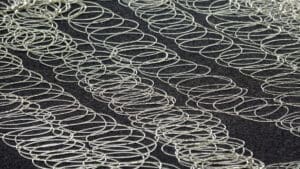
For more robust bonds, a more compact spiral pattern is recommended. For greater surface coverage, and for use on heat-sensitive materials, a wider, finer spiral is needed.
Industries That Have Adopted the Tecbond Spray System
One of the first industries to embrace this technology was the furniture industry. The greater portability of a handheld hot melt spray tool made it ideal for workers, as they could use the Tec glue gun in much the same way as the traditional solvent- and water-based solutions they were accustomed to.
With its ability to be used on heat-sensitive substrates, furniture manufacturers realised that it could be used across the entire build, from foam cushion bonding, fabric to foam bonds, and cushion to frame bonds.
Another benefit of hot melts in furniture production is their significantly faster setting speed, with zero risk of mould growth. Water-based adhesives can take several hours for the water to fully evaporate, and if any moisture remains, it can lead to mould growth in susceptible materials such as foam and fabric.
In recent years, vehicle manufacturers have adopted Tecbond spray technology for the health & safety advantages and substrate compatibility compared to the more commonly used solvent-based adhesives.
Because all Tecbond adhesives are VOC-free, workers do not require respiratory PPE when using them, and manufacturing facilities do not need air extraction or filtration equipment to operate safely. This allows businesses, especially start-ups, to significantly reduce equipment costs.
Tecbond spray adhesives also offer a much wider range of material compatibility than traditional alternatives. Manufacturers can replace two or three different adhesive systems with a single hot melt tool and one or two hot melt grades, streamlining the production process and, once again, reducing operational costs.
The Power Adhesives advantage
To this day, the range of sprayable hot melts and spray applicators from Power Adhesives remains the only reliable hot melt spray system on the global market. Combined with extensive industry knowledge and technical support from our sales team and lab technicians, Power Adhesives remains at the forefront of the hot melt adhesive market.
The Tecbond spray range revolutionised the industry in the 1990s and continues to evolve today.
To find out more about our range of sprayable tools and adhesives, visit our adhesives and applicator pages and filter by sprayable.
Tecbond 425


